This post contains affiliate links. I may earn a commission at no extra cost to you.
Quick Verdict
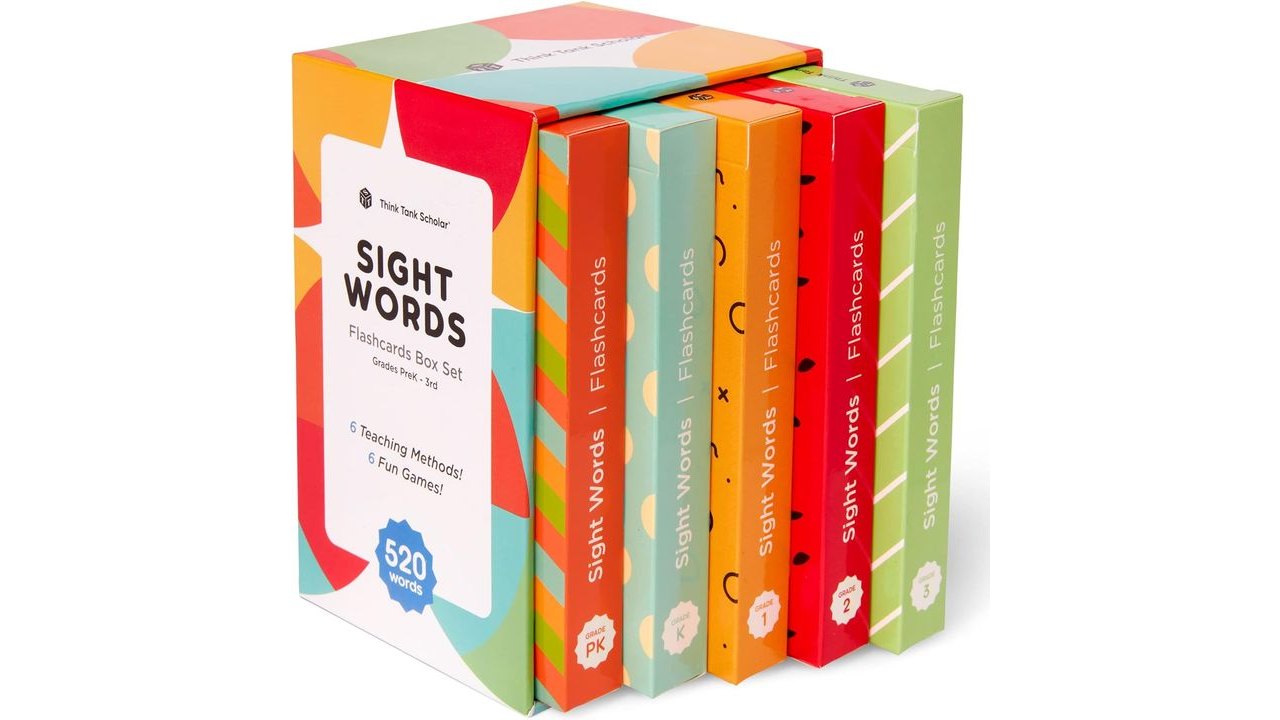
520 cards pulled from both the Dolch and Fry lists, jumbo sized at 3.2″ x 5.3″, with 6 games baked in so it doesn’t turn into rote drilling. It’s a supplement for building word recognition from Pre-K through 3rd grade, not a full phonics program, and the full count comes as five packs rather than one loose deck.
Buy if you:
- Homeschool and want words already sorted by grade level
- Have a 3 to 9 year old learning to read
- Want games and teaching methods, not just a stack to hold up
- Prefer big, coated cards over printing and laminating your own
Skip if you:
- Want a full phonics/decoding curriculum, since these teach words by sight
- Have a child needing structured dyslexia intervention
- Expected all 520 cards loose in one box rather than five packs
The Sight Words Problem Every Early Reader Hits
Roughly half of the words in a beginner’s book can’t be sounded out. Words like “the,” “was,” “said,” and “you” don’t follow tidy phonics rules, so kids have to recognize them on sight, instantly, before reading ever feels smooth. That’s the wall a lot of new readers run into, and it’s the exact gap the Award-Winning Sight Words Flash Cards are built to close. This isn’t a personal test log. It’s a plain-language buyer’s guide to what the set actually includes, who it fits, and the things worth knowing before you spend.
The pain point is usually organization, not motivation. Parents know their kid needs to master high-frequency words. What they don’t know is which words, in what order, and how to keep a four-year-old from wandering off after card number six. This set answers the first two problems by pulling from established word lists, and takes a swing at the third with built-in games.
What’s In the Box and What the Specs Mean
520 sight words flash cards, spanning Pre-K through 3rd grade, sourced from both the Dolch and Fry lists. That dual sourcing matters more than it sounds. Many schools pull high-frequency words from either the Dolch 220 or the Fry 300, so a set drawing from both lines up with a wider range of classroom word lists. Each pack also ships with 6 teaching methods and 6 learning games.
| Spec | Detail |
|---|---|
| Total cards | 520, spanning Pre-K to 3rd grade |
| Word lists | Dolch and Fry high-frequency lists |
| Card size | 3.2″ x 5.3″ (jumbo) |
| Material | Premium thick BPA-free coated cardstock |
| Card design | 3 rounded edges, 1 angled corner for sorting |
| Answer placement | Shown on the back, no flipping needed |
| Included activities | 6 teaching methods + 6 games |
| Ages | 3 to 9 years |
Translating the specs into what they buy you: the jumbo 3.2″ x 5.3″ size and large bold lettering mean small hands can grip a card and eyes can read it across a table. The coating is there so a set survives sticky fingers and repeat sessions instead of going soft after a week. And the angled corner is a genuinely practical touch, which we’ll get to.
How the Set Works in Everyday Practice
Each pack covers 120 sight words, and that count isn’t arbitrary. Those words account for up to 75% of the words found in beginner children’s books. Master a pack and a huge chunk of an early reader suddenly becomes readable, which is the kind of visible win that keeps a kid coming back.
The answer-on-the-back design is the quiet workhorse here. Because the word’s answer sits on the reverse without needing a flip, a child can self-check or an older kid can practice solo, and a parent isn’t stuck holding cards up and reading aloud the whole time. That turns a two-person chore into something a kid can do semi-independently.
Then there are the games. Six teaching strategies and six games ship with the set, and the design leans on play deliberately because rote drilling burns kids out fast. Games won’t magically make every child love flash cards, but they give you more than one way to attack the same word list, which is what usually rescues a stalled session.
The Angled Corner Is Smarter Than It Looks
Three rounded edges and one angled corner sounds like a throwaway detail until you’re mid-session. The point is sorting. As a child works through a stack, the odd corner gives you a fast, tactile way to separate mastered words from the ones still tripping them up, without stopping to read every card. For a parent tracking progress or a teacher cycling small groups, that little tab saves real minutes.
Worth Knowing Before You Buy
These teach word recognition, not decoding. A child learns to recognize “because” on sight; the cards don’t teach the phonics rules for sounding it out. If you want a complete learn-to-read system, this is a supplement to pair with a phonics program, not a replacement for one. Think Tank Scholar sells its own “Ultimate Learn to Read Bundle” that folds in 620 sight words plus 122 phonics rules, 36 games, and alphabet dice, which is the better pick if you want phonics baked in.
Two other things worth flagging. The “520-card set” is structured as multiple packs rather than one loose deck, and some listings sell individual grade-level packs, so double-check you’re ordering the full bundle if that’s what you want. And a minority of buyers, roughly 12% of aggregated reviews carried negative sentiment, have reported cards arriving bent or dinged in shipping, along with a storage box that isn’t built for classroom-volume wear. Not universal, but not nothing either.
Get it now
Award-Winning Sight Words Flash Cards – 520 High Frequency Words for Kids Ages 3–9 – Dolch & Fry List – Learn to Read for Preschool, Kindergarten, 1st, 2nd & 3rd Grade – Homeschool & Classroom Set
Get the best price on Amazon →This post contains affiliate links. I may earn a commission at no extra cost to you.
Who This Set Actually Fits
Homeschooling parents get the most out of it. The grade-sorted progression removes the guesswork of which words to teach when, and that structure is worth real money to anyone building their own curriculum. Classroom teachers can use it too, though the single-child sizing and the storage box mean a busy classroom may want a second set or a sturdier organizer.
It also lands well as a gift. Grandparents, aunts, and uncles who want to give something educational without picking the wrong grade level can lean on the Pre-K through 3rd grade span. And for a child who’s a little behind and needs extra reps at home, the self-check design makes daily practice low-effort for a tired parent.
Who it’s not for: kids who need structured literacy intervention. A child with dyslexia or a significant reading disability is better served by an Orton-Gillingham style program built for that. These cards target the typical developmental range, and pushing them as therapy sets everyone up for frustration.
How It Stacks Up Against the Alternatives
Against free printable Dolch and Fry PDFs, the trade is money for time. The printables cost nothing but demand printing, cutting, and laminating, with no games or teaching guide attached. This set’s whole pitch is turnkey packaging and durability out of the envelope.
School Zone’s sight word cards run cheaper but cover far fewer words with no bundled games, making them a bare-bones budget pick. Scholastic’s sets draw from similar Dolch sourcing with comparable card counts in some editions, but put less emphasis on physical card quality like the coating, rounded corners, and angled sort tab. Bob Books Sight Words takes a book format instead, giving stronger story context but no sorting mechanism and less flexibility for game-based drilling.
Tips to Get the Most From It
Start with the grade below where you think your child sits. Early wins build momentum, and there’s no harm in blowing through easy cards fast before hitting the ones that stick. Use the angled corner from day one to keep a “mastered” pile separate, so every session starts with the words that still need work rather than reviewing everything.
Rotate the games instead of running the same one nightly. Six methods exist precisely so a bored kid gets a fresh angle. Keep sessions short, and lean on the self-check back so your child owns the practice instead of waiting on you. If you know phonics matters for your household, plan to run this alongside a decoding program from the start rather than expecting it to teach sounding-out on its own. Ready to move on it? You can check the current price on Amazon.
Pros
- Draws from both the Dolch and Fry lists, widening classroom alignment
- Jumbo 3.2″ x 5.3″ cards with bold lettering are easy for small hands and eyes
- Answer on the back enables self-checking and solo practice
- Angled corner makes sorting mastered vs. unmastered words quick
- Six games and six teaching methods fight flash-card boredom
- Coated cardstock is built to survive repeat use
Cons
- Teaches sight recognition only, not phonics or decoding
- Full 520 count comes as multiple packs, not one loose deck
- Some reports of cards arriving bent and a flimsy storage box
- Not suited to children needing structured reading intervention
Frequently Asked Questions
Do these cover both the Dolch and Fry lists?
Yes, both. The 520 words are curated from the Dolch and Fry high-frequency lists together, not just one. Since schools pull from either list, drawing from both broadens how well the set matches your child’s classroom word list.
Are all 520 cards in one box or sold separately by grade?
The full 520-card set is structured as multiple packs rather than a single loose deck. Some listings sell individual grade-level packs, so confirm you’re ordering the complete bundle if you want every level in one purchase.
How durable are the cards?
They’re made from premium, thick, BPA-free coated cardstock designed for repeated use. A minority of buyers have reported cards arriving bent in shipping, so inspect them on arrival, but the coating is meant to hold up to daily handling.
What grade should my child start on?
Start at or slightly below where you think your child reads. The set spans Pre-K through 3rd grade, so beginning with easier words builds confidence before harder ones. Move up as each pack’s words become automatic.
Is this a phonics program?
No. These teach word recognition by sight, not decoding or sounding out. If you want phonics included, look at Think Tank Scholar’s Ultimate Learn to Read Bundle, which adds 122 phonics rules alongside the sight words.
Can one teacher use these for a whole classroom?
A single set works for small-group or one-child practice, but it’s sized and boxed for individual use. A busy classroom cycling many kids may want a second set or a sturdier storage solution, since the included box isn’t built for classroom-volume wear.
Is this better than free printable sight word cards?
It depends on your time. Free Dolch and Fry PDFs cost nothing but need printing, cutting, and laminating, with no games or guide. This set trades that money for a ready-to-use, durable deck with built-in activities.
Are the awards credible or just old?
Many of the marketed awards date to 2018 and are industry recognition programs rather than independent editorial reviews. That said, the product has picked up more recent nods as of 2023, including the Hot Diggity and NPPA awards, and carries a 4.8 Amazon rating.
Will it cover the words my child is tested on at school?
Likely a large share of them. Each pack’s 120 words account for up to 75% of words in beginner books, and pulling from both Dolch and Fry improves alignment with most school lists. Cross-check against your school’s specific list if they provide one.
Get it now
Award-Winning Sight Words Flash Cards
Get the best price on Amazon →This post contains affiliate links. I may earn a commission at no extra cost to you.