This post contains affiliate links. I may earn a commission at no extra cost to you.
Quick Verdict
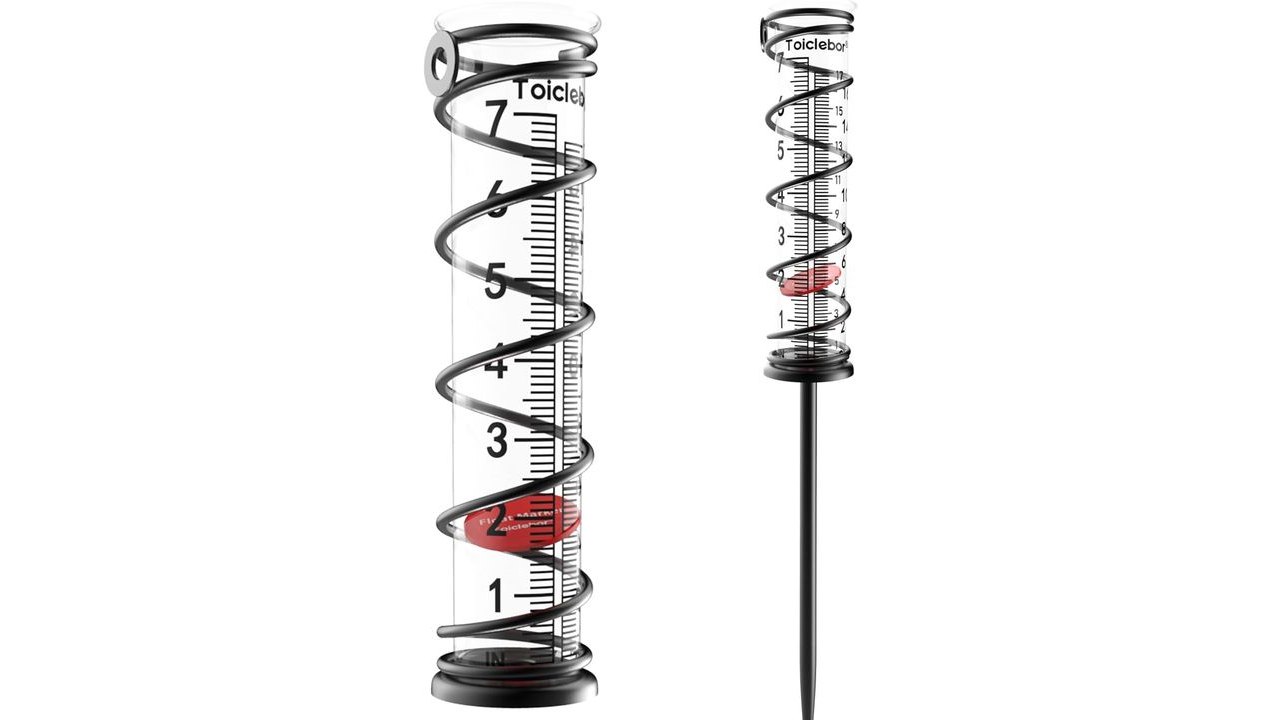
A clear glass tube, a bright red float, and a dual inch/cm scale reading up to 7 inches gives gardeners a concrete rainfall number instead of a guess. It’s a budget-to-mid analog gauge that shines in mild climates. The catch: glass and hard freezes don’t mix, so cold-region owners have to bring it in.
Buy if you:
- garden or manage a lawn and want real data before watering
- live somewhere with mild-to-moderate winters
- need both inch and centimeter readings for planting logs
- want a clean-looking glass gauge you can read at a glance
Skip if you:
- get hard freezes and won’t remember to bring the tube in each fall
- want automatic logging, alerts, or a rainfall graph on your phone
- regularly see storms that dump more than 7 inches at once
| Capacity | 7 inches / 17 cm |
|---|---|
| Scale | Dual inch & centimeter, finely divided |
| Tube material | High Boron Silicon glass |
| Float | Bright red, high-visibility |
| Mounting | Metal stand: ground insertion or wall/fence mount |
| Replacement tube | Compatible glass tube Model RM-G02 sold separately |
You’re Watering Blind Without a Number
Here’s the problem most gardeners never solve: you have no idea how much rain actually landed on your yard. The weather app says “0.4 inches,” but that reading came from a station miles away, and rain is famously local. Your neighborhood might have caught a downpour while the next town over stayed dry. So you either water anyway (and drown things) or skip it (and let beds go thirsty). The Rain Gauge Outdoor Model RM-BS7-001 exists to replace that guessing with a hard number you can read from your own garden bed.
It’s about as simple as outdoor tools get. A glass tube captures rainfall, a red float rises with the water level, and a dual inch/centimeter scale tells you exactly how much fell. No batteries, no app, no setup beyond pushing a stake into the ground. For a lot of home gardeners, that simplicity is the whole appeal.
What the features mean for your garden
The dual scale reads up to 7 inches / 17 cm with markings in both inches and centimeters. That matters more than it sounds. Planting guides and seed packets sometimes list water needs in centimeters, while farm and lawn logs usually run in inches. Having both scales printed side by side means no mental math when you record what fell.
The bright red float is the readability trick. Instead of squinting at a thin water line against glass, you look for the red marker sitting at the water’s level. It’s designed to be spotted from a few steps away, which is the difference between a gauge you check daily and one you ignore.
The tube is High Boron Silicon glass with a matte-finish metal holder. Glass has two real advantages over cheap plastic gauges: it doesn’t yellow or fade under intense sun, and it wipes clean easily. Plastic gauges are notorious for developing cloudy, hard-to-read scales after a couple of summers. The included metal stand handles both ground insertion and wall mounting, and the bracket can face up or down, so fence posts, beams, ledges, and flat walls are all fair game.
Analog accuracy vs. a digital station
A calibrated glass tube gauge is a fundamentally accurate way to measure rain, because it’s just physics: water falls in, the level rises, you read the mark. There’s no sensor drift, no dead battery, no signal to lose. The finely divided dual scale is built for precise at-a-glance readings, and for tracking daily totals and seasonal accumulation in a backyard, that’s all most people need.
One caveat worth flagging: no independent lab accuracy test exists for this specific model number, and there are no third-party side-by-side reviews of it. The accuracy claims rest on product copy and general category norms rather than outside verification. For casual garden use that’s a non-issue, but if you’re logging data for anything official, keep it in mind.
The freeze risk is the thing to know before you buy
Glass and hard freezes are a bad combination, full stop. If water sits in the tube and freezes, it expands, and even a little frozen meltwater can pop the bottom off the glass. This is the single most common complaint across the entire glass-gauge category, not just this model. The listing markets the glass as “built to withstand outdoor conditions without fading or cracking,” but that claim runs into documented freeze fragility, and experienced owners know the routine: empty the tube before frost and bring it indoors for the coldest months.
That’s not a dealbreaker for mild climates. But if you get real winters and know yourself well enough to admit the gauge will still be outside in January, the plastic-tube sibling (RM-BS7-002) or a copper/silicone freeze-proof alternative is the smarter pick. The good news for glass buyers: a compatible replacement tube (Model RM-G02) is sold separately, so a crack doesn’t mean starting over.
Get it now
Rain Gauge Outdoor Model RM-BS7-001
Get the best price on Amazon →This post contains affiliate links. I may earn a commission at no extra cost to you.
Who this gauge is actually for
Home gardeners and lawn-care owners are the core audience. If you’re deciding whether to run the sprinklers based on last night’s rain, this turns a guess into a number. It’s also a natural fit for weather hobbyists who want hyper-local data their regional forecast can’t provide, and it makes a low-fuss gift for the gardener who has most of the tools already.
It’s not for everyone. Anyone in a hard-winter region who won’t commit to bringing it in seasonally will likely watch it crack. Anyone who wants automated logging, phone alerts, or rainfall history should look at a wireless digital station instead. And anyone in a high-rainfall or tropical-storm area may find the 7-inch cap runs out mid-storm, since there’s no overflow alert to warn you a reading was lost.
How it compares to other rain gauges
The RM-BS7-001 sits in the budget-to-mid tier. It looks more substantial than a no-name plastic gauge, but it doesn’t have the freeze resilience of silicone or copper models.
Against the Toiclebor RM-BS7-002 plastic tube, you trade the clean look of glass for a freeze-proof tube and a spiral stand, which is the better call in cold climates. AcuRite wireless digital gauges self-empty, log history, and send app alerts with unlimited range, but they cost significantly more and depend on batteries, which is overkill for basic garden use. The Headwind EZRead 26″ Giant Gauge is USA-made, freeze-proof, and readable from far across a yard, at a higher price. The WCRG copper gauge is shatterproof and winter-safe with a decorative look, again costing more. And basic Taylor ClearVu 5-inch plastic gauges are cheaper and everywhere in hardware stores, but hold less, mark less precisely, and skip the float.
Setup tips and mistakes to avoid
Placement is everything. Mount the gauge away from overhanging trees, roof lines, and walls that would block or funnel rain, or your readings will be off no matter how accurate the tube is. Push the metal stake in firmly, ideally into stable soil, so wind doesn’t tip it. The up-or-down bracket gives you options for fence posts and beams if the ground won’t hold it steady.
Check it promptly after big storms so a full tube doesn’t overflow and cost you the reading, then empty it so the next measurement starts clean. To keep the float moving freely, rinse the tube periodically and let it dry rather than leaving grime or algae to build up. And the big one: set a calendar reminder to empty and store the tube before the first hard frost of the season.
Pros
- Dual inch/cm scale reading up to 7 inches, no mental conversion needed
- Bright red float is easy to read from a few steps away
- Glass tube resists sun fading and wipes clean, unlike cloudy plastic gauges
- Metal stand mounts in ground or on walls/fences, bracket faces up or down
- Compatible replacement tube (RM-G02) available if the glass breaks
Cons
- Glass tube can crack if water freezes inside; not for hard-winter neglect
- No self-emptying, logging, or alerts; it’s a purely passive analog device
- 7-inch cap can overflow in heavy storms with no warning
- No independent accuracy testing exists for this specific model
Frequently Asked Questions
How accurate is a glass float rain gauge compared to a digital one?
For backyard use, a calibrated glass tube gauge is reliably accurate because it measures rain physically rather than through a sensor. There’s no battery drift or lost signal to introduce error. A digital gauge adds convenience like logging and alerts, not necessarily better precision, though no independent lab test exists for this exact model.
Will the glass tube break in freezing temperatures?
It can, and this is the category’s most common failure. Water freezing inside expands and can pop the bottom off the thin glass. In cold climates, empty and bring the tube indoors before the first frost. If you won’t do that reliably, a plastic or copper freeze-proof gauge is the safer choice.
Is 7 inches of capacity enough?
For most regions and normal rainfall, yes. The 7-inch / 17 cm capacity covers typical daily and seasonal tracking. In tropical or high-rainfall areas, a single storm can exceed that, and since there’s no overflow alert, you’d lose the reading if you don’t check and empty it promptly.
Does the metal stand stay upright in wind?
The included metal stand is meant for ground insertion or wall mounting, so stability depends on how firmly you plant it. Push the stake deep into stable soil, or use the wall/fence bracket for windy spots. The bracket faces up or down, giving flexible placement on posts and beams.
Can I read it from a distance?
The bright red float is specifically designed to be visible from a few steps away, which is easier than reading a plain water line. For reading across a large yard, a giant-scale gauge like the Headwind EZRead is more legible at long range, but that comes at a higher price.
How do I clean the tube and keep the float from sticking?
Rinse the glass tube periodically to clear grime, algae, or sediment that can make the float stick, then let it dry. The smooth glass wipes clean more easily than cloudy plastic. Emptying it after each significant rain also helps keep readings clean and the float moving freely.
Does the manufacturer sell replacement tubes?
Yes. A compatible glass replacement tube, Model RM-G02, is listed as compatible with the RM-BS7-001 and sold separately. That’s a real advantage over gauges where a cracked tube means buying a whole new unit.
Is this a good gift for a gardener or weather hobbyist?
It works well as a gift for gardeners, lawn-care enthusiasts, and casual weather watchers who want local rainfall data without dealing with apps or batteries. The clean glass look and simple installation make it approachable. Just consider the recipient’s climate, since cold-winter regions call for the freeze-proof plastic sibling instead.
How does it compare to the plastic RM-BS7-002 model?
The RM-BS7-002 uses a freeze-proof plastic tube with a spiral stand and the same dual scale, making it the better pick for cold climates. The glass RM-BS7-001 looks cleaner and resists sun fading, but it’s vulnerable to freeze cracking. The existence of the plastic version is essentially the maker acknowledging glass isn’t ideal for year-round cold use.
Get it now
Rain Gauge Outdoor Model RM-BS7-001
Get the best price on Amazon →This post contains affiliate links. I may earn a commission at no extra cost to you.
If you garden in a mild climate and just want a concrete rainfall number instead of a guess, this is an easy one to try. The dual scale, readable red float, and available replacement tube make it a sensible pick, and you can check the current price at the link if it sounds like your situation.